
The End . . . Or theBeginning?

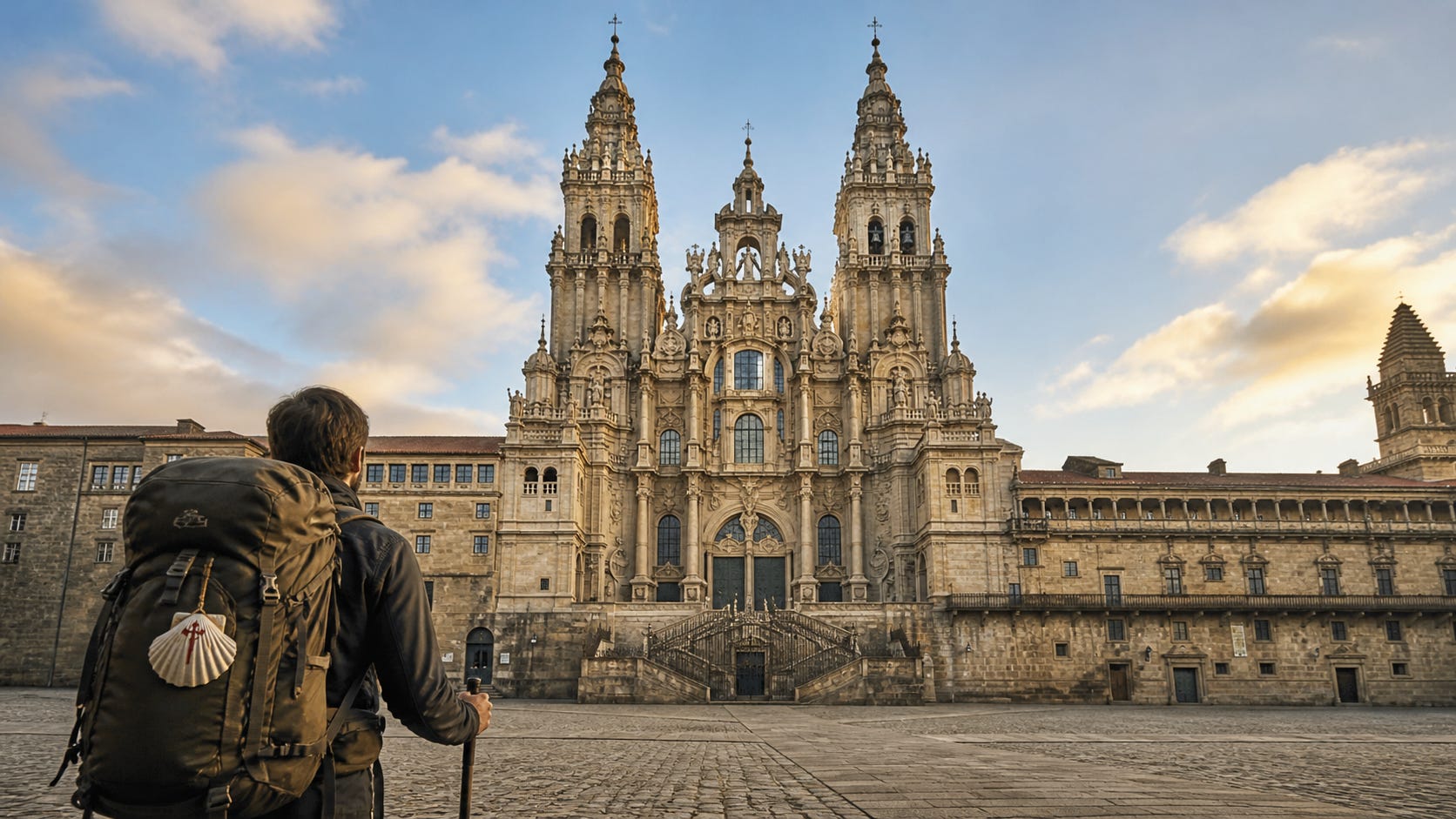
This afternoon, I sat at an outdoor restaurant in Aminal, Spain, after 15 days alone on the trail and nine miles from Santiago de Compostela, reflecting on what this journey has taught me.
Something has come into focus: I feel a deep calling to help people rekindle a sense of meaning and purpose in the second half of life — and now is the time to get serious about it.
In The Hero’s Journey, Joseph Campbell writes that the hero returns home with “boons for his people.” In a few days, I’ll return home carrying more than a few of those.
Along the way, I’ve been listening to a wonderful book by Arthur Brooks, The Meaning of Your Life: Finding Purpose in an Age of Emptiness — one I’d recommend to anyone wrestling with the question: What do I want to do with the rest of my life?
I came to the last paragraph and found this: (Copied from the book, attributed to Arthur Brooks.)
In 2019, at the not-so-young age of fifty-five, I had a burning meaning question on my mind for which I couldn’t find an answer. I had just resigned from a chief executive job that had totally consumed me for the past eleven years. I was completely burned out and had no idea what the future had in store, but deeply craved something more meaningful in my work than I had ever done before. I was looking for my calling. I knew it existed, but I couldn’t name it. To find an answer, I turned to the Camino de Santiago, which is a very long walking pilgrimage across northern Spain. For more than a thousand years, people have done it when searching for life’s meaning and purpose. Ester came with me. Each day on the Camino was like the last: We woke before dawn, walked the marked trail for about twenty miles, thought, and prayed. No devices. When pilgrims met, they greeted each other simply with “Buen camino.” Which means, more or less: May you have a fruitful pilgrimage. Sometimes we walked together with a stranger for a few miles and heard their stories. Inevitably, they, like us, were on a quiet pilgrimage to find life’s meaning. At the end of the day, we rested our aching feet and sore muscles and sank into a deep sleep. Many people say the Camino has mystical properties. They say that if you make the pilgrimage with an intention, you will find what you seek as you finish at the cathedral in the medieval city of Santiago de Compostela. And indeed, as I finished my pilgrimage, I truly felt I had found what I was seeking, and I wrote this mission statement for my remaining productive years—a description of the meaning of my work, residing deep in my right hemisphere:
I will lift people up and bring them together in bonds of happiness and love, using science and ideas.
I accepted a professorship teaching the science of happiness and began to speak and write widely for nonacademic audiences on this topic. In a very real way, this book is one of the fruits of that pilgrimage. But on reflection over the subsequent months and years, I realized that I had had it backward. I thought I was seeking my life’s meaning and found it at the end of the Camino. But in truth, I realized I had been sought all along by my life’s meaning, and the pilgrimage had simply allowed me to see it by stripping away the barriers of my complicated, distracting, messy life, and living in an old-fashioned way: without technology, in nature, with my soulmate, asking big questions. And yes, suffering plenty of physical pain. Like Levin when he just started living, my meaning found me when I was finally in the right place in my life to be found. If you want to find the meaning of your life, you must treat life like the Camino—a pilgrimage that opens your mind and heart. When you start living in this way, your life will take on an openness and a vulnerability. That’s when your meaning will find you.
Buen Camino.
Buen camino.
Welcome home